For schools and programs
Your students already have AI. This is the one that makes them work.
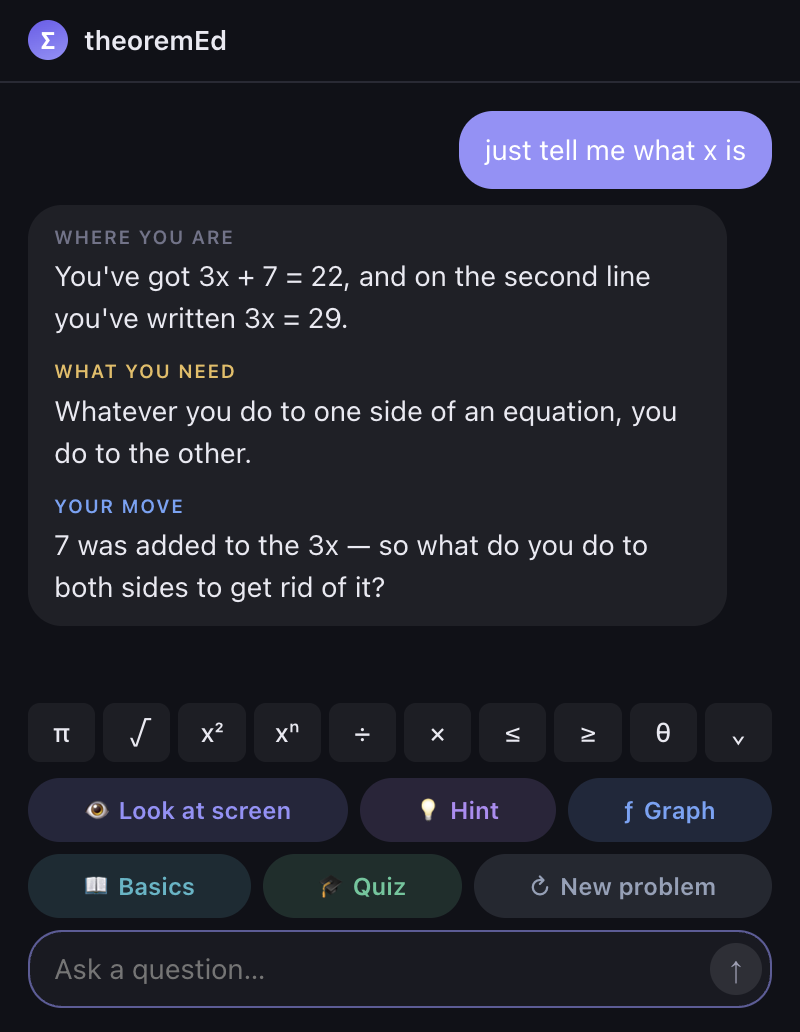
theoremEd reads the problem on a student's screen, finds the step they got wrong, and asks them about it. It will not give them the answer — not when they insist, not when they claim a teacher allows it. There is no setting that turns that off.
No accounts. No student data. Runs on managed Chromebooks.
The position you are in
Blocking it has already stopped working.
Every student in the building can have a problem set answered in four seconds, on a phone you do not control, through a site no filter has caught yet. The honour code is not the constraint it was, and the gap does not show up until the test.
So the live question is not whether they use AI. It is which one is open when they are stuck at 10pm — and that is a thing a school can actually influence.
theoremEd is the same technology, built to refuse. It finds where a student got lost and stops there. That is the whole product.
What we collect
The short answer is nothing that identifies a student. Open any of these for the detail.
Does it need student accounts?
No. There is no sign-in, no roster, no email address and no age. A student installs it and starts working. Nothing to provision, nothing to deprovision when they leave.
What student data is stored?
None that identifies anyone. On our server we keep a count of how many questions a code has asked, so limits can be enforced. That count is not attached to a name, an email, a school or a device.
On the student's own computer, the app keeps a record of the problems they worked through, so it can build practice from their weak spots. That never leaves their machine.
What does it see, and when?
A picture of the window or tab the student points it at, taken at the moment they press a button, and only then. It does not run in the background, does not read other tabs, does not touch browsing history, and injects no code into any page.
That picture goes to our server, is passed to Anthropic's API to produce the reply, and is not stored. The privacy policy is in plain English and says exactly this.
Advertising, tracking, selling data?
None of it. No advertising in the product, no tracking across sites, and nothing sold or shared with anyone.
How does it get onto school devices?
The Chrome extension runs on any managed Chromebook and can be pushed or allowlisted through the Google Admin console like any other extension. There is also a Mac app for schools that issue laptops.
It teaches, then gets out of the way
Explanations name the rule as they use it, and it stops explaining the moment a student shows they already know something.
It won't let them feel stupid
No "just", no "simply", no "as you know". Those words are how a struggling student decides to stop asking.
It starts where they are
If they are missing something from two years ago it sends them to the page that covers it, then asks them to apply it.
Mathematics only
Asked about anything else, it says so and returns to the problem. It is not a general chatbot with a subject filter.
Getting started
We would rather start with one class than a district.
The useful version of this is a small pilot: one teacher, one unit, a few weeks, and an honest answer at the end about whether students got better at the work. We will set it up, and we want the criticism more than the adoption.
Tell us about your school and what you are trying to fix, and we will come back to you.
Or email hello@theoremed.com directly. It reaches a person, not a queue.